
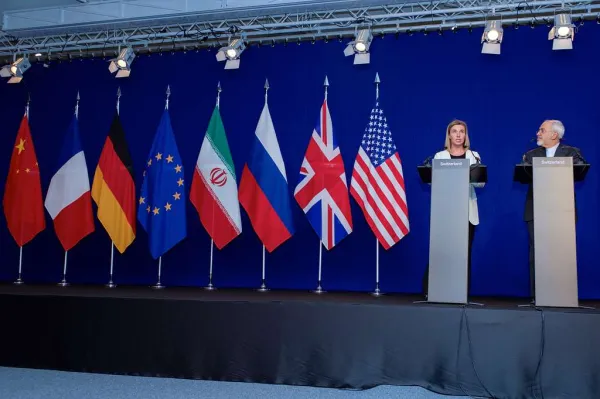
Joint Comprehensive Plan of Action: Negotiations about Iranian Nuclear Program - EU High… — PICRYL - Public Domain Media Search Engine Credit: U.S. Department of State via Picryl.com Copyright: No known copyright restrictions
The recent war involving Iran, Israel, and the United States has generated profound concern both within the Middle East and internationally. Millions have watched the escalation with apprehension, asking why the conflict has become so destructive while appearing no closer to a durable resolution. Although the immediate military confrontations dominate public attention, the roots of the conflict lie in much deeper historical, political, and structural dynamics that cannot be resolved through military means alone.
The central argument of this essay is that the Iran–Israel/United States conflict cannot be understood solely as a dispute over nuclear weapons or regional proxies. Rather, it reflects the interaction of unresolved regional security dilemmas, domestic political incentives, and an evolving international order shaped by shifting patterns of great-power competition.
At the most immediate level, the confrontation reflects decades of unresolved disputes surrounding Iran's regional policies, including its support for armed groups such as Hamas, Hezbollah in Lebanon, and the Houthis in Yemen. These tensions have been compounded by concerns over Iran's nuclear program, its long-range ballistic missile capabilities, and its broader anti-imperialist and anti-Zionist foreign policy, which has become a defining feature of the Islamic Republic since 1979. Together, these issues have produced a prolonged security dilemma in which each side interprets the other's actions as existential threats, reinforcing cycles of escalation rather than creating opportunities for compromise.
For many years, the United States attempted to manage these tensions primarily through non-military instruments. Economic sanctions, diplomatic isolation, and international monitoring under the Joint Comprehensive Plan of Action (JCPOA) sought to constrain Iran's nuclear ambitions while avoiding direct military confrontation. However, the U.S. withdrawal from the JCPOA in 2018 and the subsequent "maximum pressure" campaign marked a significant shift in strategy. Rather than producing a broader agreement, the policy intensified confrontation as Iran rejected the new demands and gradually expanded its nuclear activities.
These developments culminated in direct military confrontation during the twelve-day war of 2025 and the renewed conflict beginning on February 28, 2026. The strategic assumption behind the U.S. and Israeli campaign was that sustained internal unrest—particularly following the Women, Life, Freedom movement—had significantly weakened the Iranian state. Military planners appeared to believe that systematic attacks on Iran's military infrastructure, nuclear facilities, command structures, and political leadership, including the killing of the Supreme Leader, could trigger regime collapse through a decapitation strategy.
Yet the anticipated political collapse did not occur. Despite suffering unprecedented military losses and leadership decapitation, the Iranian state demonstrated considerable institutional resilience. Government institutions continued to function, succession mechanisms remained operational, and the political system absorbed the shock more effectively than many external observers had anticipated.
This outcome fundamentally altered the strategic landscape. From Washington's perspective, it suggested that achieving decisive political objectives would require a substantially greater military and financial commitment, with the accompanying risk of becoming entangled in a prolonged and costly regional war. Faced with these realities, the Trump administration gradually shifted toward indirect negotiations, ultimately leading to the current memorandum of understanding. In my view, this marked what I have described elsewhere as America's "Suez moment": the recognition that overwhelming military superiority does not automatically translate into political success. Like the lessons drawn from the 1956 Suez Crisis, it underscored the limits of military power in achieving durable political outcomes. Military campaigns may destroy infrastructure, degrade an adversary's capabilities, and impose significant costs, yet they cannot by themselves resolve the underlying political conflicts that gave rise to war in the first place.
This helps explain why peace remains elusive despite the enormous human costs of continued fighting. Neither side achieved its fundamental political objectives. The conflict reshaped the strategic balance but left the underlying disputes intact. Moreover, the war strengthened hardline political forces on all sides, making compromise appear domestically costly rather than strategically advantageous. As often occurs in protracted conflicts, each round of violence deepened mistrust, reinforced hostile narratives, and narrowed the political space available for negotiation.
Consequently, any lasting settlement will require considerably more than a ceasefire. Durable peace depends upon credible security guarantees, mutually acceptable political arrangements, and sustained diplomatic engagement capable of gradually rebuilding trust. Without these conditions, ceasefires are likely to remain temporary pauses in an ongoing conflict rather than genuine resolutions.
The question of who "won" the war further illustrates the complexity of modern conflict. Official narratives emerging from Iran and the so-called Axis of Resistance portray the outcome as a strategic victory, emphasizing the state's survival and its ability to withstand military pressure. Such claims are characteristic of wartime information and political warfare, where governments seek to preserve domestic legitimacy, maintain public morale, and project deterrence regardless of battlefield realities.
For ordinary Iranians, however, the experience of war is measured very differently. Rather than strategic calculations about deterrence or regional influence, daily life has been shaped by economic hardship, inflation, sanctions, infrastructure damage, insecurity, and the tightening of political repression that often accompanies wartime conditions. From this perspective, even if the state avoids military defeat or regime collapse, society may still experience significant deterioration in living standards and personal security.
These contrasting perspectives are not necessarily contradictory. Governments typically evaluate conflicts according to strategic survival and geopolitical position, whereas societies experience their consequences through material costs and social disruption. A state may successfully preserve its political system while its population bears enormous economic and human burdens. This divergence explains why competing narratives of victory frequently coexist with widespread public hardship.
Ultimately, asking whether one side simply "won" or "lost" obscures the more important analytical questions: what strategic objectives were actually achieved, what political opportunities were created or foreclosed, and at what human and economic cost? In many protracted conflicts, these dimensions do not align neatly, making absolute claims of victory analytically inadequate.
Beyond these immediate political and military considerations lies an even broader structural dimension. Some analysts argue that the conflict cannot be understood solely through debates over nuclear weapons, ballistic missiles, or proxy forces. Instead, they locate it within the larger transformation of the international system itself.
From this perspective, the Middle East occupies a central position in the dynamics of global capitalism and imperial competition. The Persian Gulf is not merely a regional theatre of conflict but a strategic node in the global circulation of energy, capital, and military power. Questions surrounding Iran's nuclear program or regional alliances therefore represent surface manifestations of deeper struggles over regional order, resource control, and geopolitical influence.
Viewed through this framework, the conflict forms part of the ongoing reconfiguration of imperialism. The relative decline of U.S. unipolar dominance alongside the rise of China as an alternative center of economic accumulation has intensified competition over energy corridors, supply chains, maritime routes, and geopolitical chokepoints. The Middle East has consequently become increasingly shaped by these global contradictions.
At the same time, regional actors should not be understood merely as passive proxies of great powers. States such as Iran actively pursue their own strategic interests while simultaneously embedding themselves within broader international rivalries. External geopolitical competition intersects with domestic political objectives, allowing ruling elites to consolidate state power, suppress dissent, and reproduce existing political and economic structures. Imperial rivalry and domestic authoritarianism therefore reinforce one another rather than operating independently.
In this sense, the present conflict reflects a broader crisis of capitalist hegemony characterized by fragmented competition among multiple state-capital formations rather than a coherent imperial project directed by any single actor. Regional and global contradictions are mutually constitutive: local conflicts shape international rivalries just as global transformations reshape regional politics.
Understanding the war therefore requires moving beyond narrow military analysis. It demands recognition that contemporary conflicts emerge simultaneously from unresolved regional disputes, domestic political struggles, and transformations in the global political economy. Only by addressing these interconnected dimensions can meaningful pathways toward lasting peace begin to em